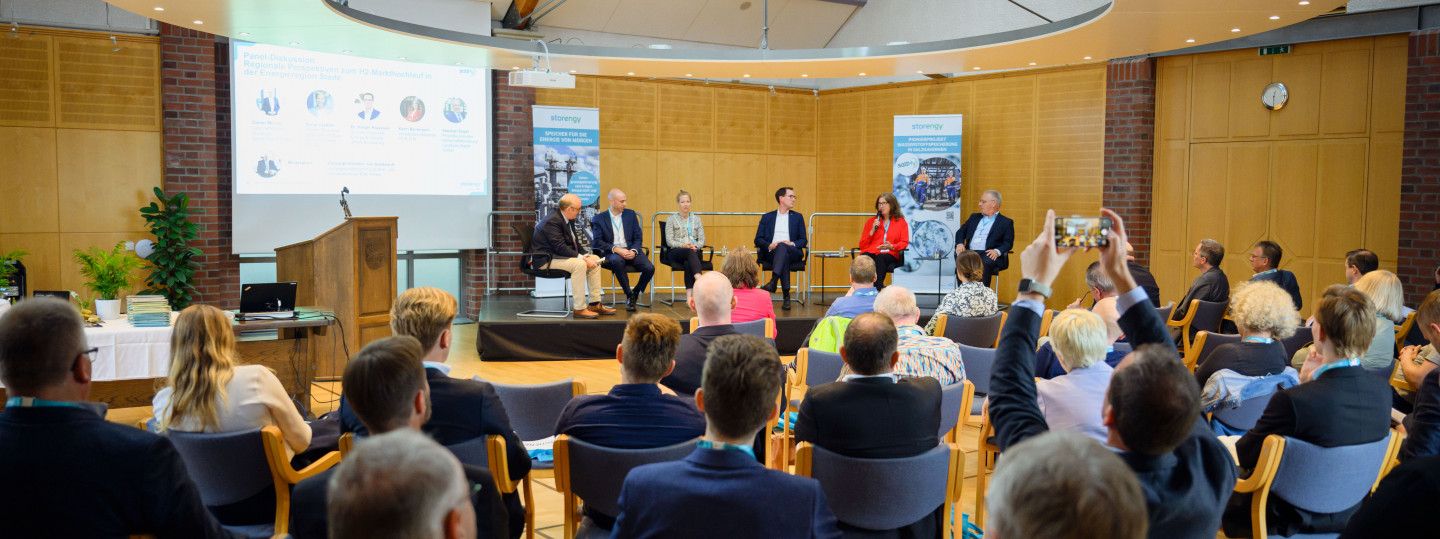
A closer look at the ramp-up of the hydrogen economy - Storengy Deutschland hosts parliamentary meeting in Harsefeld
- Political representatives from the federal, state, district and local authorities meet in Harsefeld for a dialog with H2 stakeholders from the regional hydrogen industry.
- Consensus at the event: hydrogen storage is systemically relevant.
- A successful market ramp-up requires a hydrogen storage strategy, a suitable financing model and the removal of approval hurdles.
Berlin/Harsefeld, 18.07.2025. At the invitation of Storengy Deutschland, more than 50 representatives from politics, business and industry met in Harsefeld on 15. July 2025 to discuss the current status and further development of the hydrogen economy in the Stade energy region using the planned “SaltHy” hydrogen storage system as an example.
Storengy Deutschland has initiated a dialogue format to collaborate with regional stakeholders along the hydrogen value chain, including Buss Group GmbH & Co. KG (hydrogen production) and Aurubis AG (hydrogen utilization), with the aim of identifying opportunities, challenges and key areas for action essential to the successful market ramp-up of hydrogen. These were discussed intensively in the presence of Lower Saxony's State Secretary Matthias Wunderling-Weilbier (SPD) and members of the Bundestag Dr. Andrea Lübcke (Bündnis 90/Die Grünen) and Vanessa Zobel (CDU).
"With its industry and energy sector, the Stade region makes a major contribution to making Lower Saxony the No. 1 energy state, " says Matthias Wunderling-Weilbier, State Secretary at the Lower Saxony Ministry of Economic Affairs, Transport and Building. And to keep it that way, we need hydrogen. Here, Storengy and other companies in the region are showing how the ramp-up can succeed."
Daniel Mercer, Managing Director of Storengy, expressed his great satisfaction with the strong participation, insightful discussions, and consistently positive feedback from the event, while calling for further political support: "Today's exchange highlighted the systemically relevant role of storage facilities for the H2 market ramp-up. Due to the long implementation lead times for underground hydrogen storage facilities, storage operators need investment security long before the ramp-up of hydrogen demand from industry. The pressure to act remains high here, and a hydrogen storage strategy from the German government is becoming increasingly urgent. In this context, the White Paper on Hydrogen Storage urgently needs to be adapted with regard to funding mechanisms: Revenue-based contracts for difference (CfDs) are essential for a successful ramp-up instead of demand-side support alone."
All those present agreed that Germany and Europe need a clear legal framework with the appropriate funding instruments in the long term that provides security for all players along the value chain in order to minimize financial risks and remain competitive on the global market. Furthermore, approval hurdles must be removed so that projects can be advanced quickly. The price of electricity remains the decisive factor for green hydrogen to become competitive with other energy sources.
Tour of the Harsefeld Gas Storage Facility
The event was followed by a tour of the Harsefeld gas storage facility, near the site of which the SaltHy underground hydrogen storage facility is planned. The importance of the project for the EU's energy infrastructure is underlined by its status as a Project of Common Interest (PCI). This status is a prerequisite for funding the current preparatory measures for project implementation as part of the EU Connecting Europe Facility fund. The final investment decision is scheduled for 2026. Two caverns are to be built to store around 7,000 tons of hydrogen each. Commissioning of the hydrogen storage facility with the first cavern is planned for 2032, with further caverns to be put into operation at a later date. In the future, the existing natural gas storage facility will be converted to H2 storage.
SaltHy is ideally located on the planned hydrogen core network to play a central role in the European and German hydrogen economy in the future. The geographical location with an adjacent port, H2 delivery by ship and ammonia cracking makes this region an important strategic hub for trade, logistics and industrial development related to H2.
About Storengy Deutschland
Storengy Deutschland, a company of ENGIE Group, is one of the leading gas storage companies in Germany. With around 150 employees across Germany, we are a reliable partner for storage services: we plan, build and operate storage facilities and market their storage capacities. Our mission is to store climate-neutral energy in order to sustainably supply tomorrow's generations. Therefore, we are developing innovative solutions for storing hydrogen and renewable gases. The company's headquarters are in Berlin.
About the Harsefeld gas storage facility
Storengy Deutschland (or its predecessor companies) has been operating the Harsefeld gas storage facility since 1992. Occupational safety is a top priority: the company has been operating for around 30 years without a lost time accident. The storage facility has two caverns, which were created at depths of between 1,100 meters and 1,700 meters in the solid salt of the Harsefeld salt dome. The caverns are 300 meters high, up to 50 meters in diameter and hold a total working gas volume of around 110 million standard cubic meters. Thanks to its high injection and withdrawal capacity, the Harsefeld storage facility is used for peak load balancing. Storengy is particularly committed to biodiversity and anchoring the company in its local community. With this in mind, fruit trees have been planted on the company premises, flowering meadows created and beehives set up. Furthermore, the company regularly cooperates with local organizations and volunteer fire departments.
Your contact person

Leiterin Kommunikation
Co-funded by the European Union. However, the views and opinions expressed are those of the authors only and do not necessarily reflect those of the European Union or the European Climate, Infrastructure and Environment Executive Agency (CINEA). Neither the European Union nor the funding agency can be held responsible for them.