Storage demand
Why hydrogen?
Hydrogen as a key element of fture energy systems
In order to successfully implement the energy transition and meet the climate target of greenhouse gas neutrality by 2045, we need alternatives to fossil fuels. In addition to green heat and renewable electricity, hydrogen is also essential: as a flexible energy carrier, the gas can be used, for example, where direct use of green electricity is not possible. Energy-intensive industries in particular, such as the chemical and steel industries, as well as heavy-duty transport, are dependent on hydrogen.
Hydrogen is therefore an important element of future energy systems. The German government expects annual hydrogen demand to reach 95 to 130 terawatt hours (TWh) by 2030, which corresponds to approximately 2.4 to 3.3 million tons (source: Federal Ministry for Economic Affairs and Climate Action). Our European partner countries are also dependent on hydrogen: the European Union expects annual demand to reach 20 million tons of hydrogen by 2030. Half of this demand is to be generated within Europe, with the other half imported from non-European partner countries.
Overview:
- Hydrogen is an important alternative to fossil fuels on the path towards greenhouse gas neutrality by 2045.
- H2 is an important energy source for energy-intensive industries and heavy-duty transport.
- Predicted hydrogen demand in Germany for 2030: 95-130 TWh (2.4-3.3 million tons).
- European hydrogen demand for 2030: 20 million tons (50% produced within Europe, 50% imported).

“To achieve these goals, a significant expansion of both production capacities – within and outside the EU – and import infrastructure is needed. A massive expansion of infrastructure is also necessary for transport and storage within Europe and Germany. In addition to a pipeline network for hydrogen, storage facilities are particularly important.” Daniel Mercer, Managing Director of Storengy Deutschland
H2 core network
Hydrogen infrastructure expansion
A well-developed hydrogen infrastructure is crucial for the successful integration of hydrogen as an energy carrier. It enables the safe and reliable import, storage and distribution of hydrogen in Germany and Europe.
“Hydrogen can make an important contribution to future energy and industrial systems. In order to use the potential of this gas efficiently, it is necessary to expand the transport and storage infrastructure.”
– Gunnar Assmann, Project Lead for Hydrogen Storage, Storengy Deutschland
Northern Germany plays a key role within Europe in this regard. It is home to the central hub of the European hydrogen transport core network – the so-called EU Hydrogen Backbone. The Stade region is therefore currently developing into a central hydrogen cluster. Its favorable geographical location in the heart of Europe and its adjacent port make Stade an important trading and logistics center for this energy carrier. In the future, large quantities of hydrogen and hydrogen derivatives such as ammonia are to be imported here by sea. A seamless connection between local production, import infrastructure and off-take centers (local, energy-intensive industry) is possible in Stade. In addition, northern Germany offers ideal geological conditions for the safe storage of hydrogen due to its extensive underground salt structures.

“Northern Germany is home to 80% of Europe's cavern storage capacity, making it the ‘hydrogen battery’ of Europe. The salt structures were formed over 250 million years ago in the Zechstein Sea. Today, they offer us the best geological conditions for underground storage of gases such as hydrogen.”
– Gunnar Assmann, Project Lead for Hydrogen Storage, Storengy Deutschland
With SaltHy, Storengy Deutschland is implementing one of Germany's first hydrogen storage facilities in the Stade region. Thanks to its strategic location, SaltHy can be easily connected to the emerging international transport network (Gasunie's supraregional pipeline network “HyPerLink” and the distribution network of the “Hamburg Green Hydrogen Hub”).
Overview:
- Hydrogen can replace natural gas in the industry in the medium term, but natural gas remains necessary for the time being.
- Hydrogen is a storable form of energy that enables the expansion of intermittent renewable energy sources.
- Natural gas storage facilities are still necessary to ensure security of supply.
- New hydrogen storage facilities need to be built for the new hydrogen market.
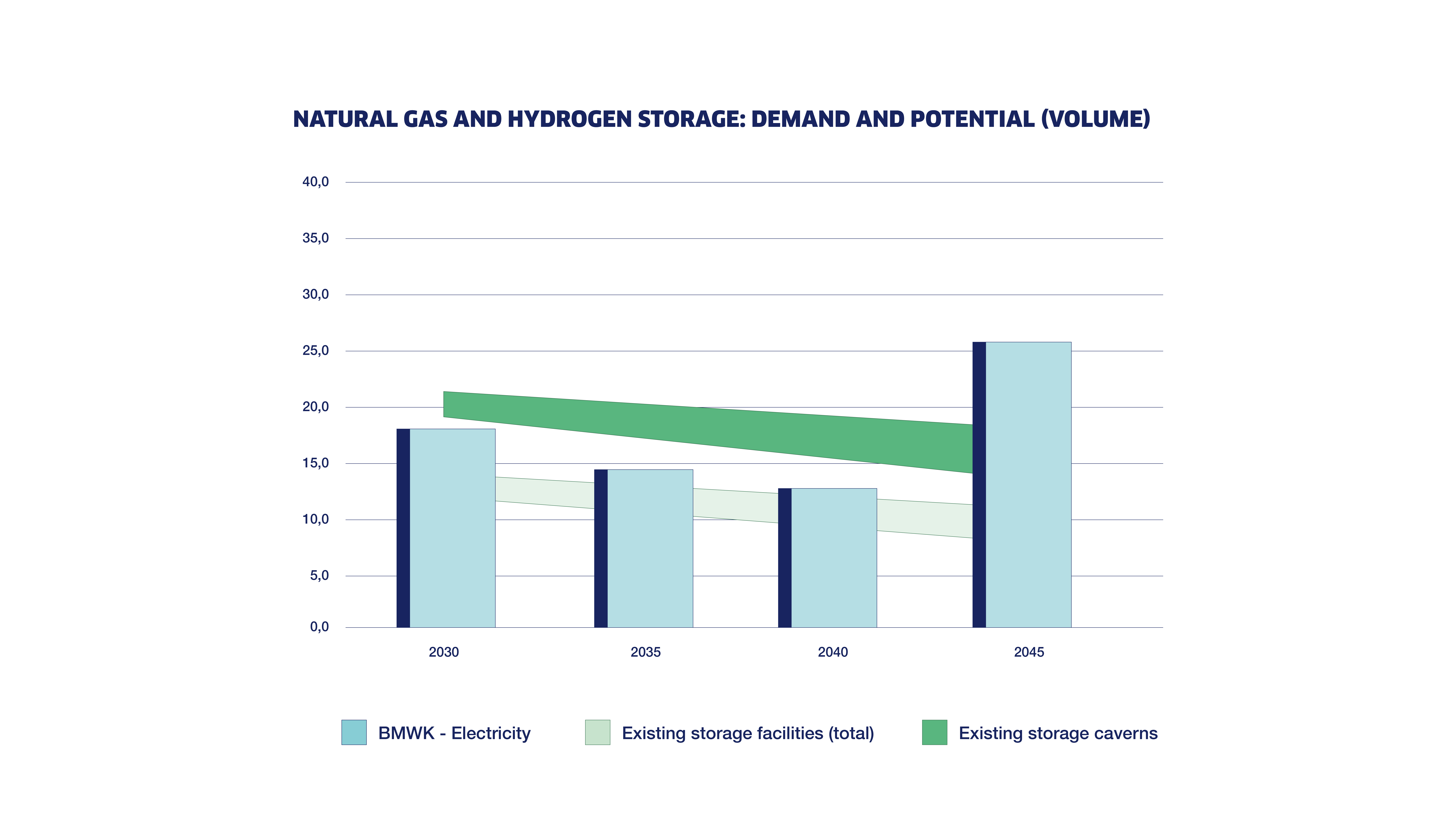
- In the long term, the storage requirements for hydrogen exceed the conversion potential of existing natural gas storage facilities.
- Due to its lower density, hydrogen requires more volume for storage than natural gas.

New construction and conversion
Only with sufficient storage infrastructure for hydrogen can the full potential of this energy source be exploited. The storage capacity of hydrogen allows for flexible use of the gas, thereby enabling a stable energy supply. For a successful market ramp-up, hydrogen storage facilities are therefore needed in addition to production and transport networks. Although existing natural gas storage facilities can be converted for hydrogen storage, the construction of new hydrogen storage facilities is still necessary.
In the medium term, hydrogen can replace the use of natural gas in the industry. However, until sufficient quantities are available and it has completely switched to the use of hydrogen, the industry will remain dependent on natural gas. Natural gas will also continue to be needed in other sectors in the coming years. To ensure security of supply in Germany, natural gas storage facilities will therefore continue to be necessary.
“We will have to continue to ensure the supply of natural gas via existing storage facilities for a long time to come. We therefore need to build new hydrogen storage facilities to secure the emerging hydrogen market.” – Gunnar Assmann, Project Lead for Hydrogen Storage, Storengy Deutschland
The construction of new hydrogen storage facilities is not merely a temporary solution: in the long term, storage requirements will exceed the conversion potential of existing natural gas storage facilities. This is not only because higher energy demand is expected in the future. Due to its lower density, hydrogen has a larger volume than natural gas when stored, meaning that more space is required for hydrogen storage.